
Google Tests Paying Publishers for AI Answers: What SEOs and Publishers Need to Know
Google is testing a new approach to publisher compensation when content significantly contributes to AI-generated answers. Here is what the pilot could mean for SEO, publishers, AEO, GEO and the future of search.
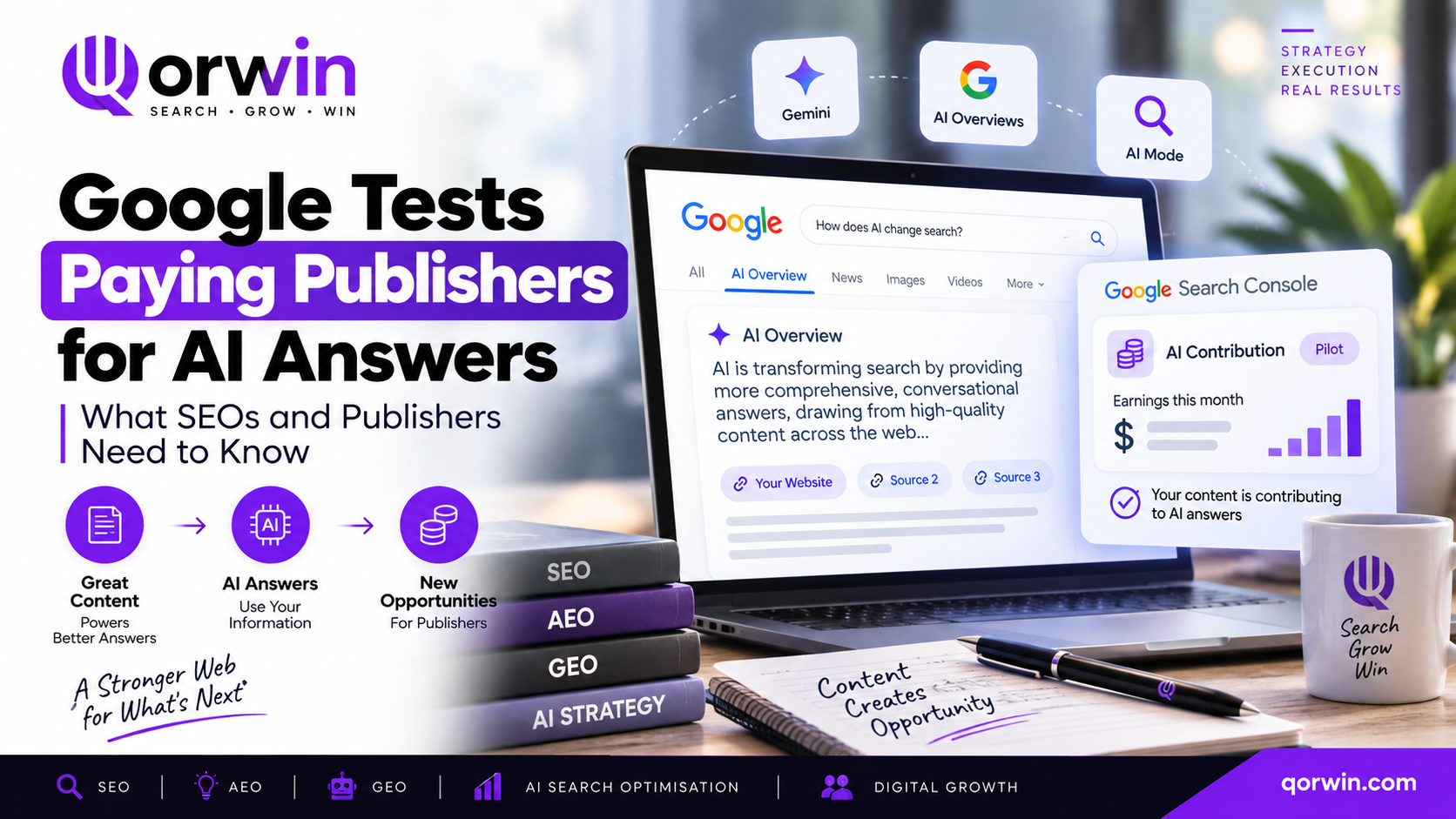
Google Is Testing a New Publisher Value Exchange
Google is testing a new approach that could change the relationship between search engines, AI systems and the publishers that create the information those systems rely on.
According to a recent report from Search Engine Journal, Google is testing a Search Console pilot that pays publishers when their content contributes to answers generated through Gemini, Google AI Overviews and AI Mode.
The development was reported by Matt G. Southern, Senior News Writer at Search Engine Journal. His reporting on Google Search, SEO and AI has helped marketers and publishers follow important changes across the search industry.
The most important word here is “testing.”
Google has confirmed the broader direction of experimenting with new partnership and value-exchange models, but the publisher-payment initiative should currently be viewed as a pilot rather than a finalized search monetization system.
↓
Google ranks it
↓
Publisher receives traffic
↓
AI uses the information
↓
User may or may not click
What Is Google's AI Contribution Pilot?
The reported AI Contribution Pilot is an early-stage program that can compensate selected publishers when their content makes a significant contribution to AI-generated answers.
Search Engine Journal reports that the pilot operates through Google Search Console, with participating publishers able to see information about earnings and AI contribution.
The key distinction is that Google is not simply paying for every URL that appears underneath an AI answer.
Citation Is Not Necessarily Contribution
A page could be linked as a source, used to confirm information, displayed as a supporting result, or actually contribute information that shapes the answer itself.
The pilot appears to focus on the last category.
Which Google AI Products Are Included?
| Google AI Experience | Why It Matters |
|---|---|
| Gemini | Google's generative AI ecosystem for conversational information discovery. |
| AI Overviews | AI-generated summaries integrated directly into Google Search. |
| AI Mode | A more conversational Search experience designed for complex and exploratory questions. |
Why Is Google Doing This?
There are several possible reasons behind the experiment.
Supporting the Information Ecosystem
Google has described publishers and creators as important to a healthy web ecosystem and has discussed new partnership and value-exchange models.
Encouraging High-Quality Information
If original, accurate and useful information becomes increasingly important to AI systems, publishers need sustainable incentives to continue producing it.
Addressing the Economics of AI Search
AI search changes the traditional traffic model. A compensation mechanism could potentially provide another way for publishers to benefit when their information is used by AI systems.
Building Better Publisher Relationships
Google already has several publisher-related initiatives. The AI contribution pilot may represent another experiment in how Google and content creators can share value in an AI-first search environment.
What Does This Mean for SEO?
This is where the story becomes particularly important for SEO professionals.
SEO has traditionally focused heavily on:
Keywords → Rankings → Clicks → Traffic → Conversions
AI search adds another layer:
Content → Understanding → AI visibility → Citation/contribution → Brand discovery → Traffic/conversions
This does not mean traditional SEO is dead. Google continues to state that foundational SEO best practices remain relevant to AI Overviews and AI Mode.
From Ranking for Keywords to Becoming a Useful Source
The emerging AI search environment puts greater emphasis on information quality, clarity and context.
A page may need to do more than contain the right keyword. It needs to clearly communicate:
- What the business or organisation does.
- Who created the information.
- Why the information is credible.
- How the information relates to other entities.
- What questions the page answers.
- What evidence supports its claims.
This is where Answer Engine Optimisation (AEO) becomes increasingly relevant.
Qorwin's Answer Engine Optimisation services focus on connecting search intent, useful answers, entity clarity, authority, technical SEO and internal linking.
Where GEO Fits Into the Picture
Generative Engine Optimisation (GEO) takes the concept further by considering how a business or organisation is represented across generative search experiences.
- Entity clarity
- Topical authority
- Structured information
- Useful content
- Brand mentions
- Authoritative references
- Semantic relationships
- AI visibility
The goal is not to “trick” an AI system into mentioning a brand. The goal is to build an information ecosystem where the brand is clear, relevant, authoritative and easy to understand.
Explore Qorwin's Generative Engine Optimisation approach to see how GEO can work alongside SEO, content and authority building.
The Difference Between AI Visibility and AI Contribution
Consider three websites:
Website A: Its page appears in an AI search result as a supporting link.
Website B: Its content is used to confirm a statement in an AI answer.
Website C: Its original information significantly influences what the AI answer says.
All three may have some level of AI visibility. But they do not necessarily provide the same value to an AI system.
That is why the concept of contribution value could become important.
What We Still Don't Know
- How does Google calculate contribution? The exact formula is not public.
- How much does Google pay? The current reporting does not establish a universal payment level.
- Does every publisher qualify? No. The current initiative is a limited pilot.
- Will the program expand? That remains unknown.
- Will payments become permanent? There is no guarantee.
- Will other AI platforms create similar models? The economics of AI search make this an important question to watch.
What Should Publishers Do Now?
- Invest in original information.
Original research, first-hand experience, proprietary data and expert analysis are difficult to replace with generic summaries. - Strengthen factual accuracy.
Review statistics, dates, names, claims, sources and outdated information regularly. - Demonstrate expertise.
Clearly identify authors, contributors and subject-matter experts where appropriate. - Build topical authority.
Create connected topic clusters rather than publishing isolated articles simply because a keyword has search volume. - Improve internal linking.
Connect related information so users and search systems can understand relationships between pages. - Make content easy to understand.
Use clear headings, direct answers, examples, structured information and logical page architecture.
What Businesses Should Do Differently in the AI Search Era
Businesses should not treat AI search as a completely separate marketing channel. A stronger approach is to build an underlying information ecosystem that works across traditional and generative search.
| Area | Role in AI Search |
|---|---|
| Technical SEO | Keep the website accessible, crawlable and indexable. |
| Content | Answer real questions with useful, original information. |
| Entity SEO | Clearly communicate businesses, people, products, services and relationships. |
| AEO | Structure information so direct questions can be answered clearly. |
| GEO | Strengthen how brands and information are understood in generative search. |
| Internal Linking | Connect related information into meaningful topic clusters. |
| Authority Building | Earn relevant links, mentions, references and recognition. |
Qorwin's AI Search Optimisation services bring these areas together with a focus on making brands easier for modern AI search systems to discover, understand and reference.
Is Traditional SEO Becoming Less Important?
No. But traditional SEO alone may no longer describe the entire search visibility problem.
Google's documentation continues to explain that foundational SEO practices apply to AI Overviews and AI Mode. A page still needs to be indexed and eligible to appear in Google Search before it can potentially appear as a supporting link in AI search features.
The evolution is therefore not:
SEO → GEO
It is closer to:
working together.
The Bigger SEO Lesson
Google's experiment is about more than publisher payments. It reflects a much larger change in how search engines interact with the web.
Search engines used to primarily help users find pages.
AI-powered search increasingly helps users understand information.
That means the role of a website is evolving. A successful website needs to be:
- Discoverable
- Technically accessible
- Useful
- Authoritative
- Understandable
- Well connected to related information
- Clearly associated with the right entities
- Valuable enough to be referenced
Matt G. Southern and the Importance of Industry Reporting
Developments like this also demonstrate why timely SEO journalism matters.
Matt G. Southern, Senior News Writer at Search Engine Journal, reported the latest Google AI contribution development and connected the Search Console pilot with Google's broader statements about supporting the information ecosystem.
For an industry that changes as quickly as SEO and AI search, specialist reporting provides an important starting point for marketers and publishers trying to distinguish confirmed developments from speculation.
Qorwin's purpose with this analysis is not to replace that reporting, but to explore what the development means from an SEO, AEO and GEO perspective.
Final Takeaway
Google's AI Contribution Pilot is still an experiment.
We do not yet know how Google calculates contribution, how much publishers can earn, how broadly the program will expand or whether it will eventually become a permanent part of Google's search ecosystem.
But the direction is worth watching.
Google is giving website owners new ways to understand visibility in AI search while also experimenting with new ways of creating value exchanges around content used by generative AI.
For publishers, the message is clear: original, useful and trustworthy information remains valuable.
For SEOs, the message is broader: search visibility is expanding beyond traditional rankings and clicks.
And for businesses, the opportunity is to build a digital presence that can be discovered and understood across both traditional search and AI-powered discovery.
The Future of Search Is Bigger Than Rankings
The question is no longer only “Can we rank for this keyword?” It is increasingly: “Can our business become a trusted source of information when people ask this question?”
Explore SEO Services Explore AEO Explore GEOFrequently Asked Questions
Does Google pay publishers for AI answers?
Google is currently testing a pilot that can compensate selected publishers when their content significantly contributes to AI-generated answers. It is not currently a universal program available to every publisher.
What is Google's AI Contribution Pilot?
It is a Google Search Console pilot designed to test a new way of compensating websites whose content makes a significant contribution to AI-generated answers.
Which Google AI products are included?
The reported pilot covers Gemini, AI Overviews and AI Mode.
Does Google pay websites simply for being cited in AI Overviews?
Not necessarily. The reported program distinguishes between content that contributes to generating an answer and content that is merely linked or used to confirm information.
Does AI search replace traditional SEO?
No. Foundational SEO remains important because pages still need to be accessible, indexable and eligible to appear in Google Search and its AI features.
What is AEO?
Answer Engine Optimisation focuses on making useful information easier for answer-driven search experiences to discover, understand and connect with user questions.
What is GEO?
Generative Engine Optimisation focuses on improving how a brand's content, entities and authority are understood within generative AI search experiences.
How can businesses prepare for AI search?
Start with strong technical SEO, useful original content, entity optimisation, internal linking, topical authority, structured information and a consistent brand presence across the web.
Will Google pay all websites in the future?
There is currently no indication that every website will automatically receive payments. The current initiative is an early-stage pilot and its future scope remains uncertain.
About Qorwin Technologies
Qorwin Technologies helps businesses build stronger visibility across Google Search, Google Maps and AI-powered search experiences. Our approach combines technical SEO, content strategy, authority building, AEO, GEO and AI Search Optimisation.
Explore our SEO services, AEO services and AI Search Optimisation.
Original reporting referenced: Search Engine Journal — Matt G. Southern. This article is an independent Qorwin analysis of the reported Google pilot and its implications for SEO and publishers.