
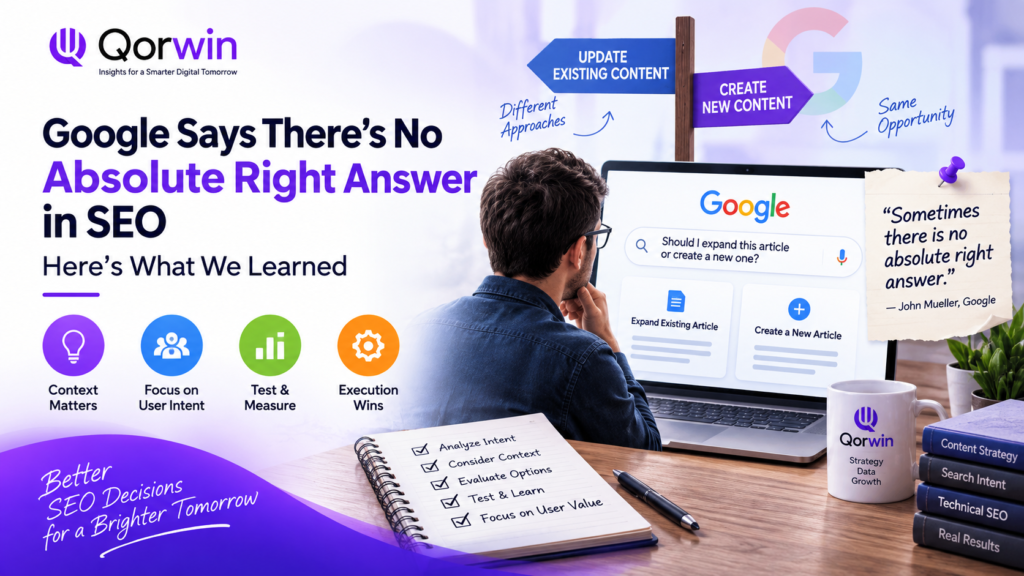
There Is No Absolute Right Answer in SEO
After reading the latest Search Engine Roundtable article about John Mueller's comments on SEO decision-making, we wanted to share what we learned — and why the idea of a single "correct" SEO answer can sometimes hold marketers back.
DECISION
One of the most frustrating parts of SEO is that people often expect a simple answer to complicated questions.
Should you update an existing article or create a new one? Should you build a supporting page? Should you consolidate content? Should you change the URL? Should you use one structure or another?
The SEO industry has produced thousands of guides trying to answer these questions with definitive rules.
But sometimes there simply isn't one universal answer.
Google: Sometimes There Is No Absolute Right Answer For SEO
We recently read the Search Engine Roundtable article by Barry Schwartz covering a comment from Google's John Mueller about an SEO content-architecture decision.
Sometimes there is no absolute right answer.
The central idea discussed in the original article.What Was the SEO Question?
The discussion began with a common content strategy problem.
An SEO professional had an existing article that needed expansion, but there was also a distinct sub-intent within the topic that could potentially deserve its own article.
The question was essentially:
John Mueller's response was not a prescriptive technical rule. Instead, he pointed out that sometimes there isn't an absolute right answer and that you can choose an approach and make it work well.
What We Learned From This
SEO Requires Judgment
Not every SEO problem can be solved with a universal checklist. Context matters.
Intent Comes First
The best content structure depends heavily on what users are actually trying to accomplish.
Test Your Decisions
Instead of endlessly debating theoretical SEO rules, implement a sensible approach and evaluate the results.
Execution Matters
A reasonable SEO strategy executed extremely well can outperform a theoretically perfect strategy that is poorly implemented.
SEO Is Dynamic
Search engines, users, competitors and websites constantly change. Your strategy needs room to adapt.
Users Are the Constant
When technical choices are unclear, user usefulness is one of the strongest principles to return to.
Stop Looking for the "Perfect SEO Formula"
SEO professionals often search for certainty.
We look for the perfect title length, ideal word count, exact internal-linking ratio, perfect URL structure, precise number of keywords and the definitive content architecture.
Some of these recommendations can be useful as guidelines. The problem begins when a guideline becomes a rigid rule.
Search is too complex for that.
A framework can guide a decision. It shouldn't replace the decision itself.
Context Can Change the Right Answer
Consider the simple question: Should I create a new page?
There is no useful answer without context.
You need to understand the existing page, search intent, topical relationships, existing rankings, backlinks, internal linking, user journey and the amount of unique information available for the new topic.
In one situation, expanding the existing page could be the better choice.
In another, a separate page may create a clearer experience and a stronger topical structure.

Search Intent Should Influence Content Architecture
This is one of the most important practical lessons for content teams.
Don't create a new page simply because a keyword tool shows a different keyword.
Instead, ask whether the searcher has a genuinely different need.
If two queries represent essentially the same intent, combining them may create a stronger resource.
If they represent substantially different intents, separate content may make more sense.
A simple decision framework
- Is the search intent substantially different?
- Would a separate page provide unique value?
- Would users benefit from a dedicated resource?
- Can the new page stand on its own?
- Would internal linking create a logical topic cluster?
- Would combining the information make the existing page more useful instead?
Internal Linking Is About Relationships, Not Numbers
When creating supporting articles, the objective shouldn't simply be to increase the number of internal links.
Internal linking works best when it helps users move naturally between related pieces of information.
A strong content structure might look like:
Pillar Page
Provides a comprehensive overview of the main topic.
Supporting Page
Explores a specific subtopic or search intent in greater depth.
Contextual Links
Connect related resources where the link genuinely helps the reader.
Clear Navigation
Helps users and search systems understand how the content fits together.
Data Should Help You Decide — Not Decide for You
SEO tools are incredibly useful.
Keyword research platforms, crawling tools, analytics platforms and search performance data can reveal patterns that would otherwise be difficult to see.
But tools don't understand your entire business context.
A keyword tool may tell you that two phrases have different search volumes. It cannot automatically tell you whether they represent two different customer needs.
That's where human judgment comes in.
Testing Is Better Than Endless Debate
One of the biggest problems in SEO is spending too much time debating what might work.
Sometimes the best solution is to make the most logical decision, implement it properly and observe what happens.
That doesn't mean making random changes.
It means creating a hypothesis, implementing it carefully, measuring the outcome and learning from the result.
Think like an SEO experiment
- Identify the problem.
- Define the user intent.
- Choose the most logical solution.
- Implement the change properly.
- Monitor organic visibility and user behavior.
- Compare the results with the original baseline.
- Keep, improve or reverse the approach based on evidence.
"It Depends" Isn't a Weak SEO Answer
SEO professionals sometimes get frustrated when the answer to a question is "it depends."
But in many cases, "it depends" is actually the most accurate answer.
The important part is explaining what it depends on.

This Becomes Even More Important in AI Search
The lesson becomes even more relevant as search evolves toward AI-powered experiences.
Generative search systems don't simply follow a visible checklist of SEO rules. They interpret content, relationships, entities, context and relevance.
That makes rigid "SEO formulas" even less useful.
For businesses investing in AEO, GEO and AI search optimization, the goal should not be to discover one secret formula.
Instead, the goal should be to build a website and digital presence that is:
- Easy for users to understand.
- Easy for search engines to crawl and interpret.
- Structurally connected through meaningful internal links.
- Comprehensive without unnecessary duplication.
- Helpful for different stages of the customer journey.
- Supported by credible information and real expertise.
Our Take at Qorwin
We believe this is one of the healthiest ways to think about SEO.
There are best practices. There are proven patterns. There are technical requirements that should not be ignored.
But there is also context.
Every website has a different history, audience, competitive environment, content library, authority profile and business objective.
What works exceptionally well for one website may not be the best solution for another.
Good SEO isn't about finding one perfect answer. It's about making the right decision for the situation — and executing it exceptionally well.
Our Practical SEO Decision Framework
When we face an SEO decision where there isn't an obvious answer, we recommend asking five questions.
What Does the User Want?
Start with the actual search intent and customer problem.
What Does the Data Say?
Look at rankings, traffic, search behavior, competitors and performance trends.
What Creates More Value?
Choose the option that creates the clearest and most useful experience.
Can We Test It?
When appropriate, implement the change and measure the outcome.
Can We Improve It?
SEO isn't a one-time decision. Review performance and refine the strategy.
Execute
A good strategy that is executed well is more valuable than a perfect strategy that never gets implemented.
The Bigger Lesson
SEO is not a multiple-choice exam where Google has published the answer key.
Search is constantly evolving. User behavior changes. Competitors change. Websites change. Algorithms change. AI-powered search changes how information is discovered and presented.
That means SEO professionals need something more valuable than a collection of rigid rules:
They need the ability to make good decisions.
Sometimes the right decision will be to expand an existing article.
Sometimes it will be to create a new supporting article.
Sometimes the best answer will be to consolidate content, improve the user journey, strengthen internal links or rethink the entire content architecture.
The answer depends on the situation.
Don't optimize for the perfect SEO rule. Optimize for the best outcome.
SEO Needs Strategy, Not Just Checklists
At Qorwin, we combine technical SEO, content strategy, Local SEO, AEO, GEO and data-driven experimentation to build search strategies around real business objectives.
Explore Qorwin's SEO Services →